Imagine this: You’re in the Arctic Ocean, treading water above the ice. Suddenly, a shadow emerges behind you. Before your brain has time to process what’s happening, you’re already dead.
This is the harsh reality of the sperm whale. They live in pods and use clicks to communicate. An adult male can reach about 15 to 18 metres (50 to 60 feet) in length, with a head roughly 5 to 6 metres (16 to 20 feet) long. Their enormous, square-shaped heads account for roughly one-third of their entire body length.
Unlike many other whales, sperm whales dive deep into the ocean to hunt giant squid, only coming to the surface to breathe! But something is seriously crazy about these animals.
A sperm whale’s echolocation clicks can reach approximately 230 decibels underwater. That’s louder than a jet engine at take-off (around 150 dB). In fact, these sounds are incredibly powerful, and there are claims that they could be deadly to a human swimming nearby. Sperm whales use these sounds not just to navigate the pitch-black abyss, but also to locate and hunt their prey.
But don’t worry! There are no documented records of wild sperm whales intentionally hunting, killing, or eating humans. In modern times, interactions between humans and sperm whales have generally been peaceful.
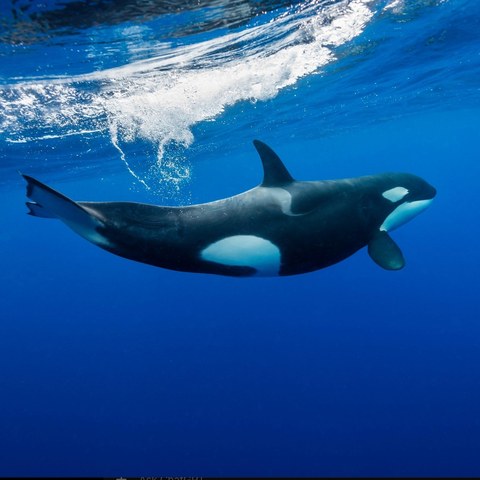
When we think of the ocean's greatest predator we think of a great white shark... but nobody talks about the orca (the killer whale). I wonder where it gets its name! They live in groups called pods and plan attacks through a language of clicks and whistles, but don't be fooled, this animal is truly vicious and smart! An adult male orca typically weighs between 8,000 and 12,000 pounds (3,628 to 5,442 kg). But even though it hunts great white sharks and large whales it does not eat humans! Why doesn't it eat humans? We are slow weak and pretty much just flesh. So why don't orcas eat us? Well there are many answers but one reason is, they don't recognise us as food in their natural habitat. Plus we won't taste very good. And is not worth the energy. Humans are tiny and won't sustain an orca's need for energy. not for long at least. So in conclusion, you shouldn't be afraid of orcas. The only times they have ever killed people is in captivity there are no recorded cases of them ever killing people in the wild.
The diving bell spider is one of the strangest spiders on Earth. It lives underwater in parts of Europe and Asia and spends almost its entire life beneath the surface.
But there is one big problem: spiders need oxygen! The diving bell spider solves this problem by building a special underwater web called a diving bell. The spider carries tiny bubbles of air down from the surface and stores them inside the web.
The spider can hide inside its air-filled home, breathe, rest, eat, and even lay eggs there. When its air supply gets low, it returns to the surface to collect more.
It is the only spider known to spend almost its entire life underwater. Imagine finding a spider's house at the bottom of a pond!
Mudskippers are unusual fish that live around muddy shores and mangrove forests in parts of Africa, Asia, and Australia. Unlike most fish, mudskippers can spend a lot of time out of water. They use their strong fins to push themselves across mud and even climb over rocks and tree roots.
Mudskippers can breathe while they are out of water as long as their skin stays wet. They can also keep water in their bodies and use the moist lining of their mouths to take in oxygen. Some mudskippers even build muddy homes called burrows.
Scientists study these strange fish because they may help us understand how ancient animals eventually adapted to living on land. They look like fish, but they move around on land like tiny frogs!