Imagine this: You’re in the Arctic Ocean, treading water above the ice. Suddenly, a shadow emerges behind you. Before your brain has time to process what’s happening, you’re already dead.
This is the harsh reality of the sperm whale. They live in pods and use clicks to communicate. An adult male can reach about 15 to 18 metres (50 to 60 feet) in length, with a head roughly 5 to 6 metres (16 to 20 feet) long. Their enormous, square-shaped heads account for roughly one-third of their entire body length.
Unlike many other whales, sperm whales dive deep into the ocean to hunt giant squid, only coming to the surface to breathe! But something is seriously crazy about these animals.
A sperm whale’s echolocation clicks can reach approximately 230 decibels underwater. That’s louder than a jet engine at take-off (around 150 dB). In fact, these sounds are incredibly powerful, and there are claims that they could be deadly to a human swimming nearby. Sperm whales use these sounds not just to navigate the pitch-black abyss, but also to locate and hunt their prey.
But don’t worry! There are no documented records of wild sperm whales intentionally hunting, killing, or eating humans. In modern times, interactions between humans and sperm whales have generally been peaceful.
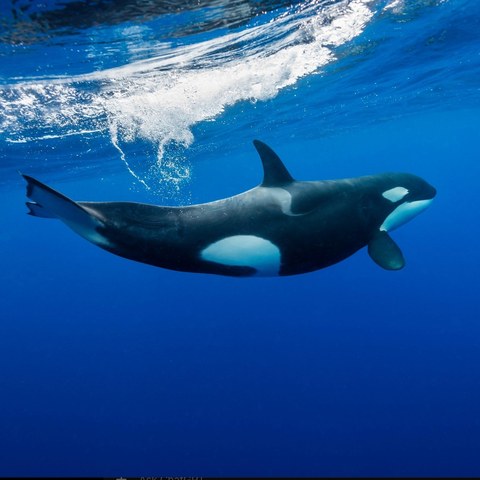
When we think of the ocean's greatest predator we think of a great white shark... but nobody talks about the orca (the killer whale). I wonder where it gets its name! They live in groups called pods and plan attacks through a language of clicks and whistles, but don't be fooled, this animal is truly vicious and smart! An adult male orca typically weighs between 8,000 and 12,000 pounds (3,628 to 5,442 kg). But even though it hunts great white sharks and large whales it does not eat humans! Why doesn't it eat humans? We are slow weak and pretty much just flesh. So why don't orcas eat us? Well there are many answers but one reason is, they don't recognise us as food in their natural habitat. Plus we won't taste very good. And is not worth the energy. Humans are tiny and won't sustain an orca's need for energy. not for long at least. So in conclusion, you shouldn't be afraid of orcas. The only times they have ever killed people is in captivity there are no recorded cases of them ever killing people in the wild.
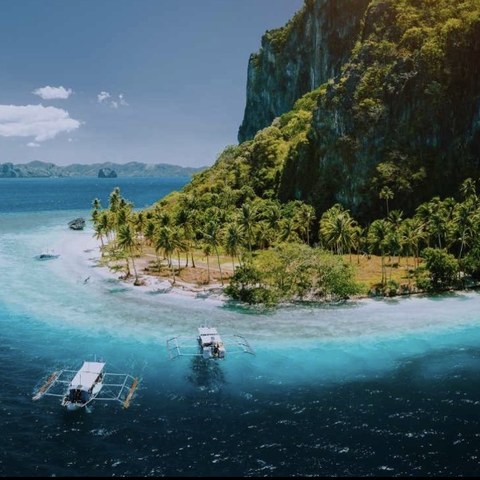
The Philippines is a country located in south east with a current population of around 117 million. The capital of the Philippines is Manila on Luzon island. Other city’s are Boracay, Bagio and Bohol. There are 3 main islands in the Philippines: Luzon, Visayas and Mindanao.The national animal is the carabao.
Nature - the Sampaguita
The Sampaguita is the Filipino national flower. In Filipino society, the Sampaguita has a lot of importance. It stands for simplicity, purity, modesty, and power. It is often linked to traits like toughness, tenacity, and patience, which makes it a beloved symbol of the Filipino spirit.
Traditions
In the Philippines Christmas starts at the start of the ber months, AKA September. And it ends at the START of January. Thats a full 4 months of Christmas!!! It started off as a Joke and now it’s become a tradition.
FUN FACT!
The Philippines is a country made from 7641 islands.
Imagine having one ball and somehow turning it into two identical balls without adding any extra material. Sounds impossible, right? Surprisingly, mathematics has a theorem that describes exactly that!
It's called the Banach–Tarski paradox, and it's one of the strangest results in mathematics.
So, how does it work?
In 1924, mathematicians Stefan Banach and Alfred Tarski proved that, under the usual mathematical assumptions, a solid ball in three-dimensional space can be split into a finite number of sets and rearranged to form two identical copies of the original ball.
But there's a catch: these aren't normal pieces you'd get by cutting a ball with a knife. They're extremely unusual collections of mathematical points, so you couldn't physically separate them and put them back together like puzzle pieces.
Why doesn't the ball's volume stay the same?
Normally, if you cut an object into pieces and rearrange them, the total volume stays the same. But the sets used in the Banach–Tarski paradox are non-measurable. That means they can't be assigned ordinary volumes in the usual mathematical way, so the familiar rules of adding volumes don't apply.
The proof also relies on a mathematical idea called the Axiom of Choice. This principle allows mathematicians to select elements from collections of sets, even in situations involving infinitely many sets where no explicit selection rule is given.
Does this mean we can duplicate real objects?
No! You can't use the Banach–Tarski paradox to make two basketballs from one, duplicate food, or create extra matter. It's a result about abstract mathematics, not a method for physically copying objects.
Want to explore the paradox further?
I've created a lesson about the Banach–Tarski paradox in Flaura Learn. You can explore the ideas in more detail, discover why the theorem works, and take a quiz with explanations to test your understanding.
Plants can't move around like animals, but they can grow toward light. You can test this yourself with a plant at home!
🧪 What you'll need
* 🌱 A small potted plant
* 📦 A cardboard box
* ✂️ Scissors
* ☀️ A sunny window
* 📏 A ruler
🔬 Try it at home!
1. Make the box
Cut a small hole in one side of the cardboard box.
2. Add the plant
Put the plant inside the box. Make sure the hole is facing a sunny window.
3. Wait
Leave the box near the window for 3–5 days. Try not to move it.
4. Check your plant
Look at it each day. Is it growing straight, or is it bending toward the hole?
5. Record your results
Use a ruler to measure the plant each day and write down what you notice.
👀 What will happen?
After a few days, you may see the plant bending toward the light! ☀️🌱
This is called phototropism. It's a plant's way of responding to light as it grows.
This is the first of (hopefully) many flaggles that I Felix (a.k.a. SirFelixTheFantasticCookieThe3rd) will be making.
How it works:
I will be posting one of these hopefully whenever I can and it will have an image of a country's flag attached to it, then in a quiz you have to guess what flag it is.
P.S you are allowed to use Google
Hope you have a brilliant time.
😃
Modular Arithmetic is where numbers loop back. It can be very complicated, but you can learn it very quickly. Take these two equations (down below), which one is right?
8 + 6 = 14 or 8 + 6 ≡ 2
You might be wondering what the "≡" means or what the difference is between "≡" and "=" is, well, the = means that the numbers left of the = are equal to the following. The ≡ means that the the answer won't be above the loop number, it will go back to 1 and count on from there.
The loop number is basically the maximum number it will go to. So for our example from earlier, say it's a clock, so the loop number would be 12.
8 + 6 ≡ 2
For this example, 8 could be the time we went to bed. 6 could be the time we slept for. And 2 would be the outcome, remember in this example our loop number is 12 since its a clock example.
You may be wondering how do we write that we loop back at that number.
Well you could write that as:
( mod 12)*
*That's for the clock example
You can find Modular Arithmetic everywhere,
In cars, on the odometer,
On calendars, the months loop,
In real life, time on a clock.
This survey tell us, How do we spell names?
Choose the one that seems the coolest or your own name (If it's there) or choose a person that you know with the spelling. Answers on 1st of October
ENJOY :D
The UN has voted to change the official world map to show the true size of Africa.
The Mercator map (the old map we used) was designed in 1569 by the Flemish cartographer Gerardus Mercator to help European explorers navigate across the world. On these maps, Africa is the same size as Greenland, which is not true. Africa is 14 times larger than Greenland!
Online campaign group #CorrectTheMap said: "You could fit the United States, China, India, Japan, Mexico and much of Europe into Africa and still have land to spare."
This new map will be called the "Equal Earth Project" and will be phased into Australian classrooms.
The diving bell spider is one of the strangest spiders on Earth. It lives underwater in parts of Europe and Asia and spends almost its entire life beneath the surface.
But there is one big problem: spiders need oxygen! The diving bell spider solves this problem by building a special underwater web called a diving bell. The spider carries tiny bubbles of air down from the surface and stores them inside the web.
The spider can hide inside its air-filled home, breathe, rest, eat, and even lay eggs there. When its air supply gets low, it returns to the surface to collect more.
It is the only spider known to spend almost its entire life underwater. Imagine finding a spider's house at the bottom of a pond!
Mudskippers are unusual fish that live around muddy shores and mangrove forests in parts of Africa, Asia, and Australia. Unlike most fish, mudskippers can spend a lot of time out of water. They use their strong fins to push themselves across mud and even climb over rocks and tree roots.
Mudskippers can breathe while they are out of water as long as their skin stays wet. They can also keep water in their bodies and use the moist lining of their mouths to take in oxygen. Some mudskippers even build muddy homes called burrows.
Scientists study these strange fish because they may help us understand how ancient animals eventually adapted to living on land. They look like fish, but they move around on land like tiny frogs!